EMT Practice Test

1. Question Content...


Question List

Question1: What are the key steps to implement currency conversion in a calculation view?

Question2: What are some of the restrictions that apply when defining parallelization blocks in calculation views?
Note: There are 2 correct answers to this question.

Question3: Which tool generates and executes the SQL for a specific node of your calculation view?

Question4: Why would you use parameter mapping in a calculation view?Note: There are 2 correct answers to this question.

Question5: What are the consequences of NOT executing a delta merge?Note: There are 2 correct answers to this question.

Question6: Why might you use the Keep Flag property in an aggregation node?
Question7: What can you identify using Performance Analysis mode?Note: There are 2 correct answers to this question.

Question8: Which of the following techniques can you use to improve the performance of calculation views?Note:
There are 2 correct answers to this question.

Question9: At which levels of a project structure can you execute a deploy operation?Note: There are 2 correct answers to this question.

Question10: Why would an SQL developer work with SQLScript?Note: There are 3 correct answers to this question.

Question11: Which components are part of SAP HANA Cloud?Note: There are 2 correct answers to this question.

Question12: What are possible consequences of unfolding?Note: There are 2 correct answers to this question.

Question13: In a calculation view, your table function node executes a table function that requires input parameters.
How can you fill the input parameters of the table function? Note: There are 3 correct answers to this question.

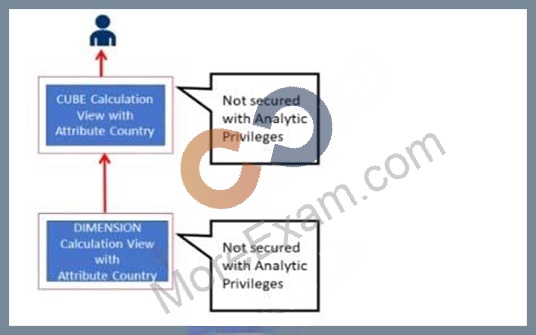
Question14: Referring to the diagram,

which privileges would a user require to view United States data when querying the CUBE calculation view?

Question15: Why would you enable Debug Query mode in a calculation view?

Question16: In Business Application Studio, you rename a DIMENSION calculation view that is used by a CUBE calculation view. You do NOT use the option to rename the runtime view and adjust the reference.
Afterward, you perform the following deploy operations:Deploy the DIMENSION calculation view as a single object.Deploy the entire SAP HANA database module.What is the outcome of the deploy operations?

Question17: When is the first column store compression executed?

Question18: You want to join two tables in a calculation view.Why do you use a non-equi join?
Question19: Which calendar types can be selected when creating time-based DIMENSIONS?Note: There are 2 correct answers to this question.

Question20: Why would you choose an HDI-shared service plan instead of a schema service plan?Note: There are 3 correct answers to this question.

Question21: You set the Null Handling property for an attribute but do not set a default value.What is displayed when null values are found in a column of data type NVARCHAR?

Question22: Using the table in the diagram, you need to create a CUBE calculation view.
What is the simplest approach to create the output shown in the screenshot?

Question23: What are some of the typical roles in an SAP HANA Cloud implementation?Note: There are 2 correct answers to this question.

Question24: What are some of the typical tasks performed by the SAP HANA Cloud modeler role? Note: There are 2 correct answers to this question.

Question25: You want to ensure that your calculation view does not give unexpected results for a query that is based on any combination of columns.What is the recommended approach for verifying the results?

Question26: Which type of join supports a temporal condition in a calculation view?
Question27: You have defined a pruning configuration table in a calculation view.What are you attempting to prune from the query execution?

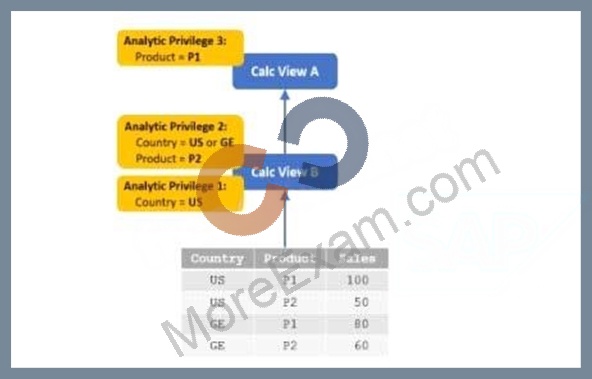
Question28: Two calculation views, A and B, are defined as shown in the diagram. Three analytic privileges have been granted to you.

When you preview calculation view A, what data do you see?

Question29: Which solutions form the SAP Business Technology Platform? Note: There are 2 correct answers to this question.